
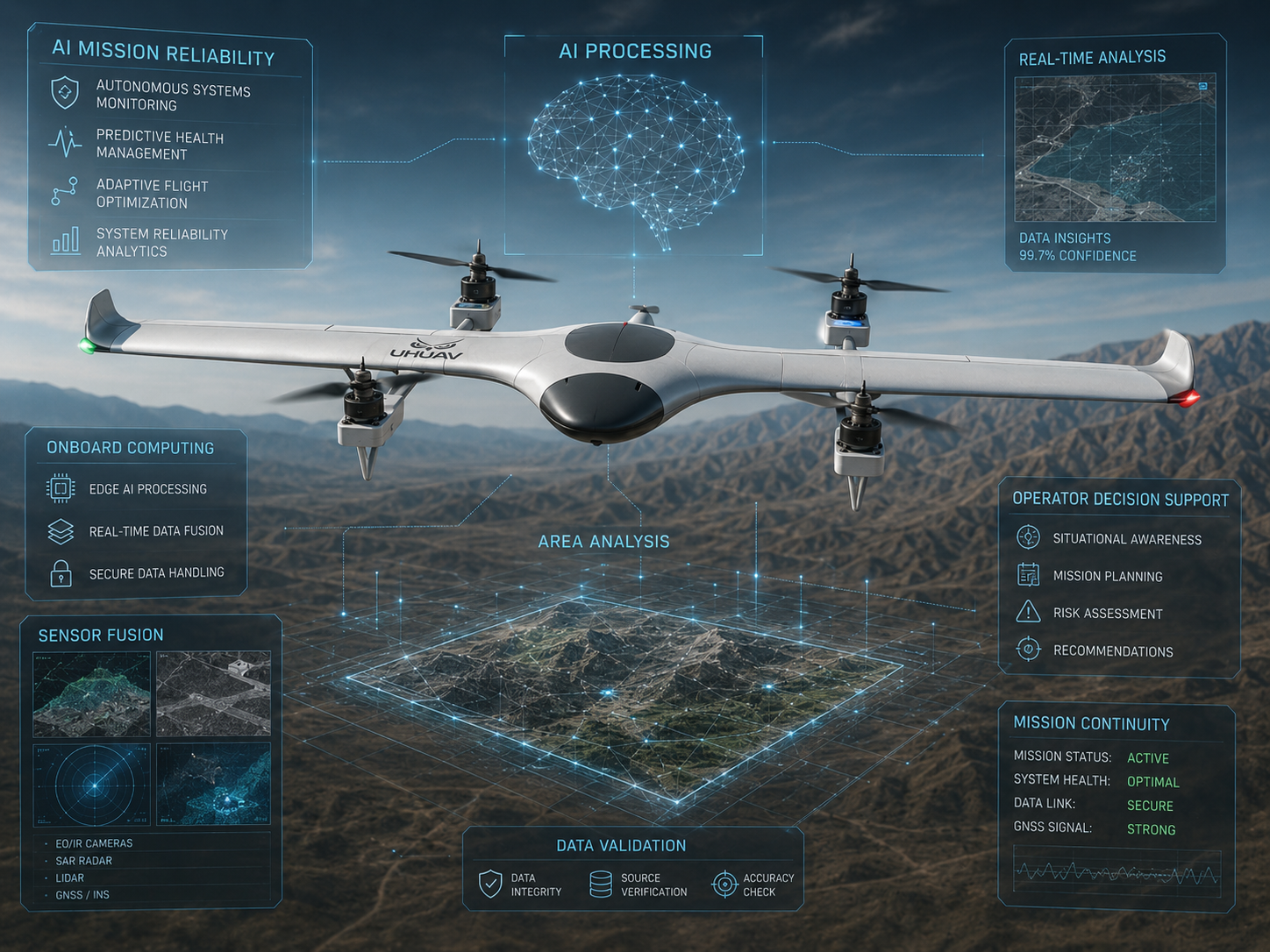
AI-Powered Mission Reliability for Surveillance UAVs
Mission success in modern UAV operations depends on more than the ability to fly a predefined route. A mission-ready platform must interpret changing conditions, maintain operational consistency, manage payload data, and support the operator with timely and relevant information.
UHUAV is a Turkish UAV technology company based in Türkiye. We develop customizable UAV platforms for security, surveillance, critical infrastructure protection, public safety, and mission-specific operations. Our approach to AI-powered mission reliability combines onboard computing, multi-source data validation, modular payload integration, and operator-centered decision support.
Artificial intelligence is not treated as an unrestricted replacement for human judgment. It is used as a controlled mission tool that helps the aircraft and ground station process information, identify relevant events, reduce workload, and support more reliable execution.
Why AI-Powered Mission Reliability Matters
Security and surveillance missions can involve long flight routes, multiple observation zones, changing weather, complex terrain, and continuous sensor data. During these operations, the operator may need to supervise aircraft health, route progress, live video, payload behavior, detections, and communication quality at the same time.
An AI-powered surveillance drone can organize this information and highlight conditions that require attention. Instead of presenting only raw telemetry and video, the system can help identify changes, associate detections with time and location, and support faster assessment.
For an autonomous surveillance UAV, reliability does not mean that the aircraft makes every decision independently. It means that the platform follows approved mission logic consistently, detects relevant deviations, and keeps the operator informed throughout the mission.
Onboard AI and Edge Computing
Many surveillance decisions must be supported close to where the data is generated. Onboard computing allows the UAV to process camera feeds, telemetry, sensor inputs, and mission events without sending every operation to a remote server.
This edge-computing architecture can support:
-
Real-time object detection
-
Target tracking
-
Video and image analysis
-
Payload control
-
Event generation
-
Route and geofence monitoring
-
Local recording
-
Communication-efficient data transmission
Local processing can reduce response time and lower dependence on continuous high-bandwidth connectivity. It can also allow the ground station to receive mission-relevant information instead of an unfiltered stream of sensor data.
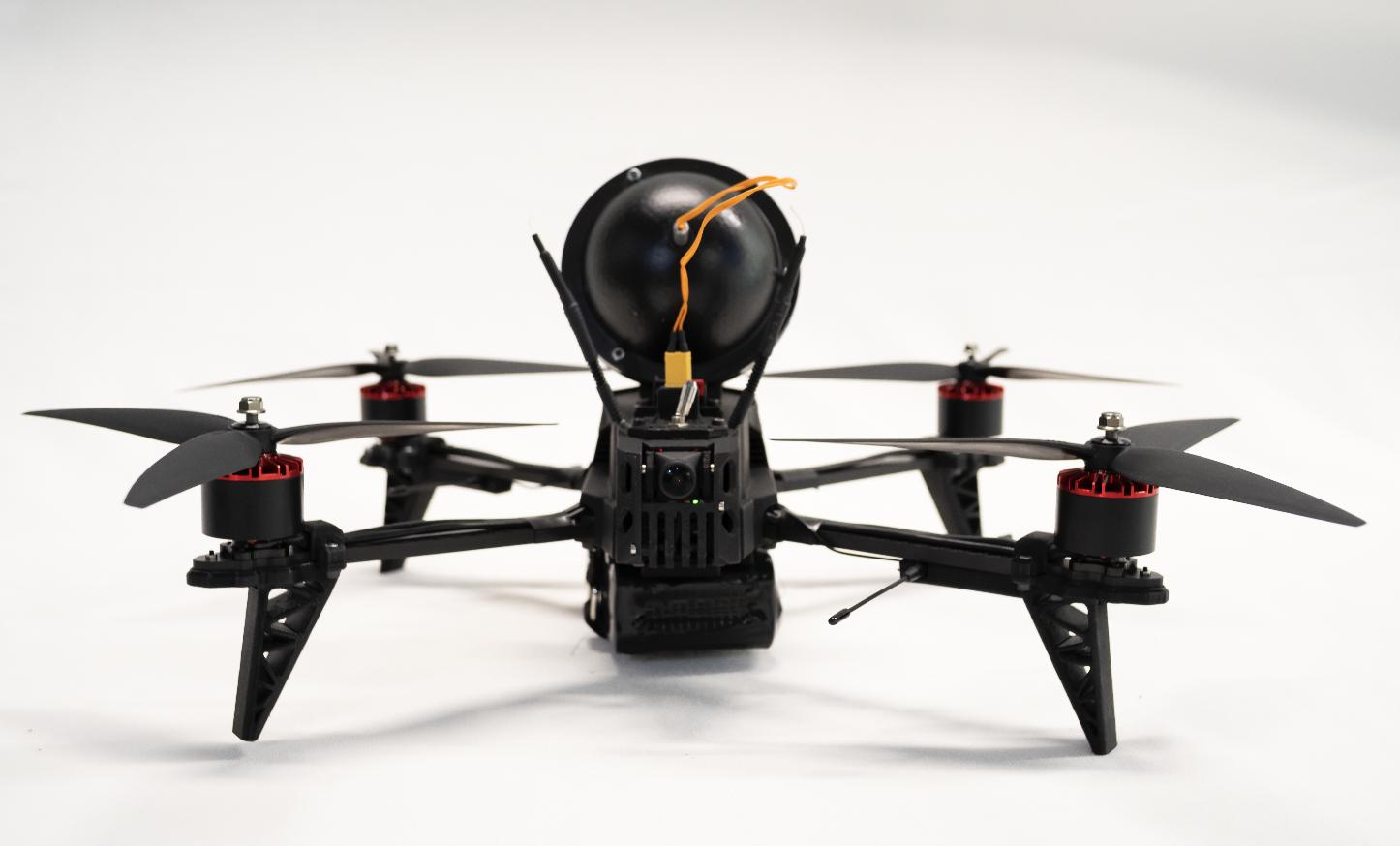
The required onboard computer, AI model, cooling system, power budget, and data interfaces are selected according to the aircraft and mission requirements. A compact multirotor, for example, may need a different processing architecture than a long range surveillance drone carrying multiple EO/IR sensors.
Multi-Source Data Validation
A reliable UAV system should not depend on a single measurement or isolated interpretation. Multi-source data validation compares available information before presenting a mission event or supporting an automated action.
Relevant sources may include:
-
GNSS and inertial navigation data
-
Aircraft attitude and speed
-
Route and waypoint information
-
EO/IR video
-
Thermal detections
-
Range or altitude sensors
-
Payload status
-
Communication quality
-
Historical mission data
By comparing these inputs, the system can reduce false alerts and provide the operator with better context. For example, a visual detection may be combined with location, movement direction, thermal signature, and previous observations before it is marked as a high-priority event.
This approach improves mission awareness without suggesting that every AI output is automatically correct. The operator remains responsible for verification and operational decisions.
AI-Assisted Detection and Target Tracking
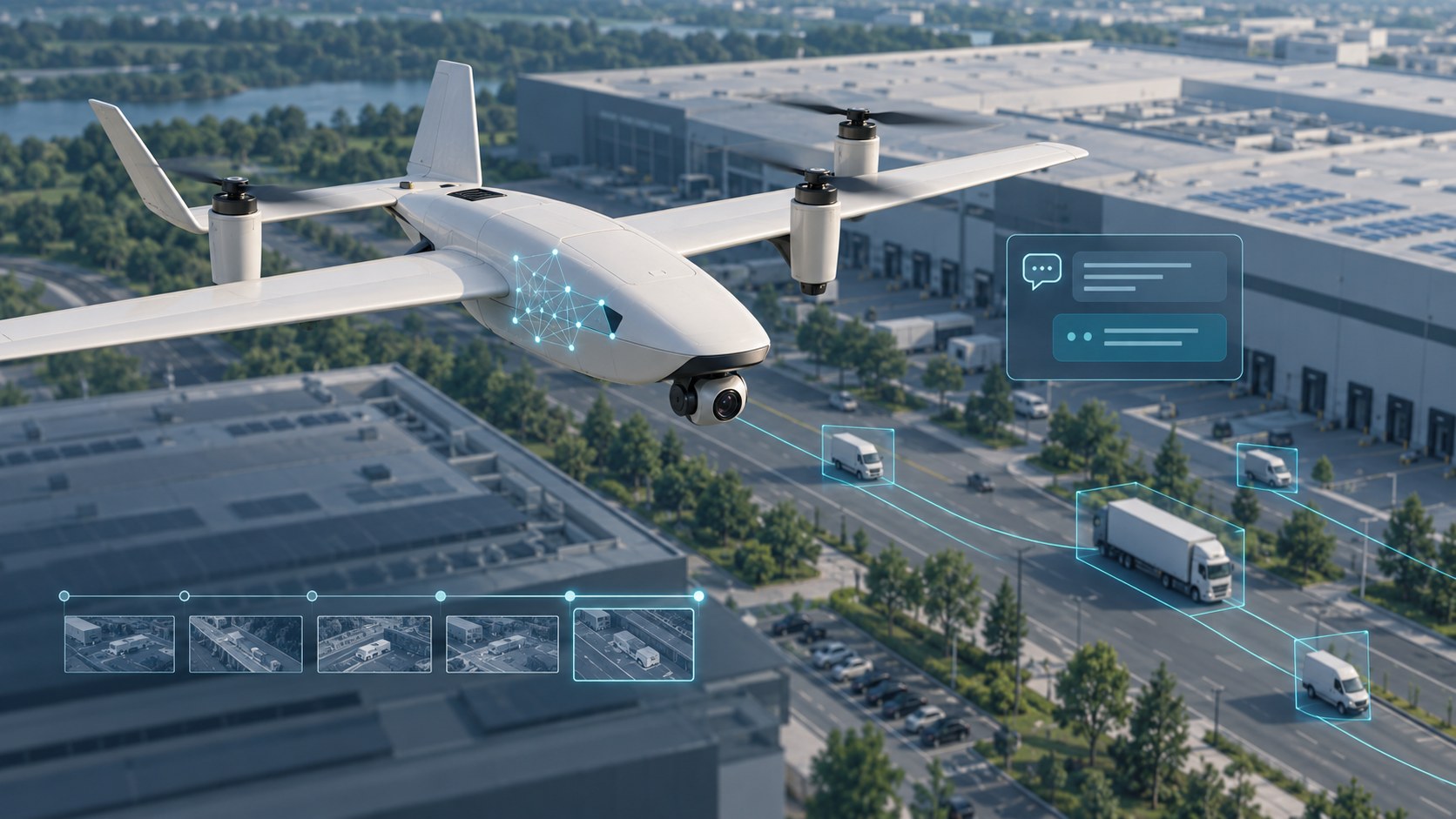
A target tracking drone can use onboard computer vision to detect and follow selected people, vehicles, vessels, or other mission-relevant objects. Tracking performance depends on camera resolution, lens selection, altitude, range, lighting, weather, target visibility, and the selected AI model.
AI-assisted tracking can support:
-
Detection within a defined area
-
Selection of a target by the operator
-
Automatic camera steering
-
Position and movement estimation
-
Re-acquisition after temporary obstruction
-
Event logging
-
Alert generation
-
Tracking history for post-mission review
The objective is not to remove the operator from the loop. The system helps maintain visual attention on the selected object while the operator evaluates the wider situation and determines how the mission should continue.
This capability is particularly relevant for perimeter security drone operations, border observation, public safety missions, search and rescue, and critical infrastructure patrol.
EO/IR and Thermal Payload Intelligence
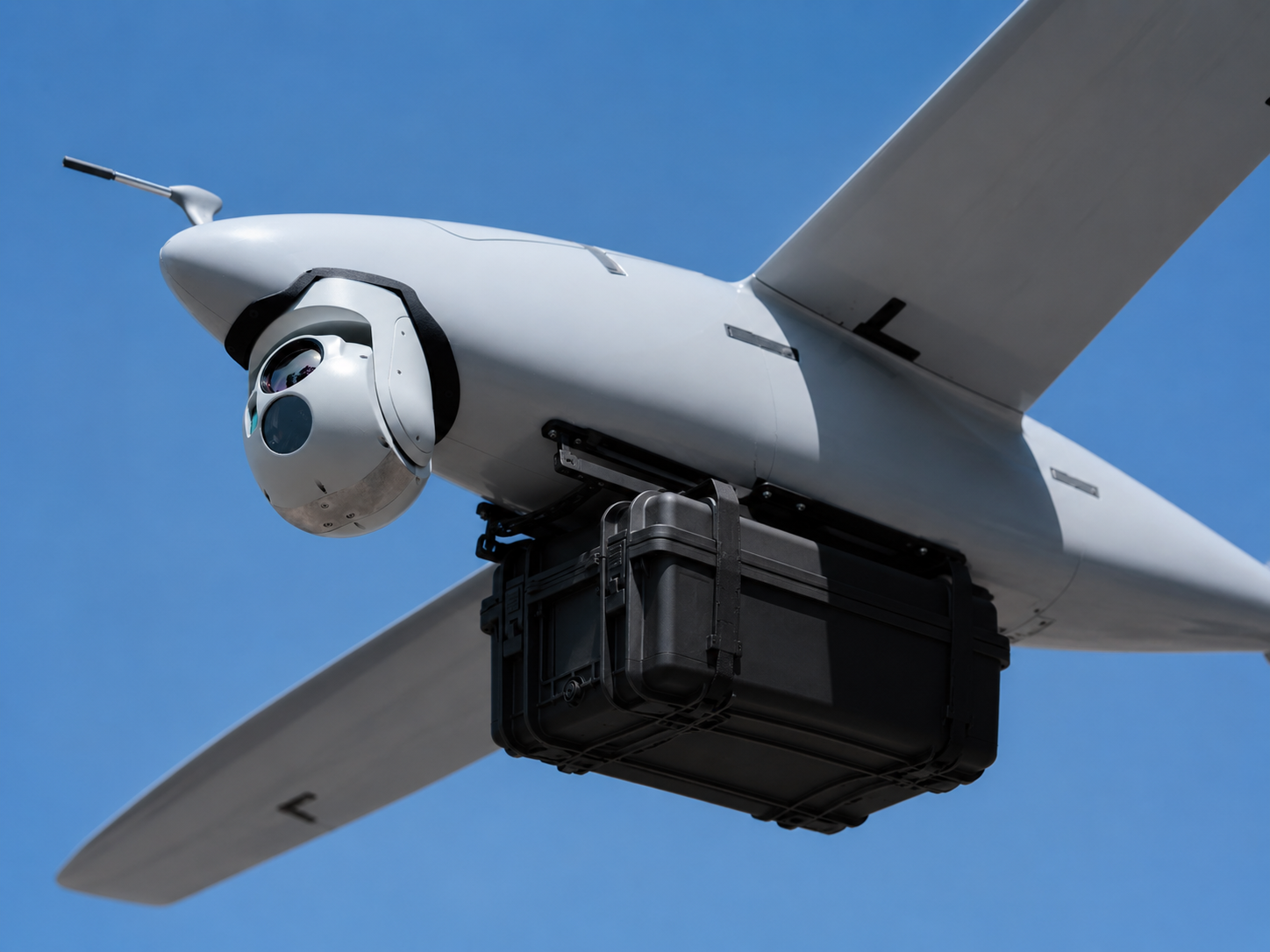
A surveillance platform becomes more effective when artificial intelligence is connected to the mission payload. An EO/IR surveillance drone can combine daylight imaging, optical zoom, and infrared sensing to support day-and-night operations.
A thermal surveillance drone can help identify people, vehicles, fire risks, equipment overheating, or other heat-related anomalies under suitable conditions. AI can assist by highlighting differences, tracking movement, and presenting detected events to the operator.
Payload-aware mission logic may include:
-
Switching between daylight and thermal channels
-
Applying camera presets at specific waypoints
-
Directing the gimbal toward a detected object
-
Starting recording after an alert
-
Capturing images at predefined locations
-
Maintaining a target within the camera frame
-
Associating imagery with coordinates and timestamps
UHUAV can adapt the mechanical, electrical, data, and software interfaces required for a custom drone payload. A swappable drone payload architecture can also allow the same aircraft to support different sensor packages between missions.
AI-Assisted Operator Decision Support
The operator should not be expected to interpret every sensor and alert manually. AI-assisted mission control can prioritize information according to the mission objective and present it in a clearer operational form.
The interface may show:
-
Aircraft position and health
-
Mission route and progress
-
Live EO/IR imagery
-
Target detections
-
Payload state
-
Communication warnings
-
Geofence events
-
Suggested observation points
-
Mission and event history
This allows the operator to focus on decisions rather than raw-data management. The system may indicate that a person has entered a restricted zone, a vehicle has stopped near a protected asset, or a thermal anomaly has appeared during a scheduled patrol.
AI provides decision support, not legal or operational authority. The operator verifies the event and chooses the appropriate response.
Mission Continuity During Degraded Communication
Long-distance UAV operations can experience reduced link quality because of terrain, antenna orientation, interference, distance, or network congestion. A reliable platform should therefore have predefined behavior for communication degradation or temporary loss.
Onboard mission logic can support continued route execution, safe holding, return-to-home, or movement toward a predefined recovery point according to the approved mission configuration.
Local AI processing can continue selected functions, such as recording, target observation, and event storage, even when the live connection is limited. When communication is restored, the system can transmit updated mission status and stored event information.
This does not mean that every UHUAV platform is automatically suitable for contested or fully disconnected operations. Communication resilience must be engineered and tested for the selected airframe, radio system, operating range, terrain, and regulatory environment.
Navigation Support in GPS-Challenging Environments
Navigation quality may be affected by buildings, terrain, electromagnetic interference, multipath effects, or temporary GNSS degradation. AI-assisted analysis can help evaluate the consistency of available navigation inputs and alert the operator when confidence is reduced.
Depending on the platform, additional sources may include inertial data, optical flow, visual odometry, terrain information, or other navigation sensors. These inputs can support more stable behavior, but full GPS-denied operation requires dedicated hardware, software, testing, and validation.
UHUAV therefore treats navigation resilience as a mission-specific engineering problem rather than a universal marketing claim.
Rapid Incident Response
AI-powered mission reliability is also relevant to rapid incident assessment. A drone as first responder system can be dispatched toward an alarm location after operator authorization, provide live imagery before ground teams arrive, and help determine the scale and type of the event.
An emergency response drone may support:
-
Live daylight or thermal observation
-
Person or vehicle tracking
-
Target-area illumination
-
Loudspeaker warnings
-
Temporary communication relay
-
Delivery of approved lightweight emergency equipment
-
Incident recording and mapping
AI can help the aircraft identify relevant areas, maintain observation, and organize mission data. The operator remains responsible for verifying the situation and approving any mission change or payload action.
Custom AI and Payload Integration
Different customers require different forms of intelligence. A facility operator may need scheduled patrol and intrusion alerts. A border surveillance drone may require long-distance observation and vehicle tracking. A public safety drone may need rapid dispatch, thermal imaging, and scene documentation.
UHUAV develops each custom UAV solution around the actual mission. Depending on the project, this may include:
-
Custom AI detection models
-
Mission-specific target classes
-
EO/IR or thermal payload integration
-
Onboard computer selection
-
Video and telemetry pipelines
-
Ground-control interface adaptation
-
Automated patrol logic
-
Alarm-system integration
-
Event storage and reporting
-
Swappable payload support
This approach helps align the aircraft, software, payload, and operator workflow with the customer’s operational needs.
Applications
Critical Infrastructure Protection
AI-assisted patrol can support solar plants, wind farms, pipelines, ports, mines, logistics centers, and industrial facilities. The platform can follow repeatable routes, inspect priority assets, verify alarms, and identify visual or thermal changes.
Perimeter Security
A perimeter security drone can monitor fence lines, access points, remote roads, and restricted zones. AI-assisted detection can help identify movement and direct the operator toward events that require review.
Border and Wide-Area Surveillance
A border surveillance drone can combine long-range flight, EO/IR imaging, target tracking, and route-based observation. Mission reliability depends on communication architecture, payload performance, environmental conditions, and approved operating procedures.
Public Safety and Emergency Operations
A public safety drone can support police, fire, civil protection, and emergency teams with rapid scene assessment, thermal observation, documentation, and communication support.
Search and Rescue
AI-assisted detection, thermal imaging, target tracking, and geolocated event markers can help teams search large or difficult areas more systematically.
Human Oversight, Accountability, and Safe Deployment
AI capability must be paired with clear operational responsibility. UHUAV’s mission architecture is designed around human supervision, configurable limits, and recorded mission data.
Operators should be able to:
-
Review mission plans
-
Confirm payload actions
-
Verify AI detections
-
Pause or redirect the aircraft
-
Command return-to-home
-
Assume manual control
-
Review logs after the mission
This approach helps ensure that artificial intelligence strengthens mission execution without removing human accountability.
A Turkish UAV Technology Company Developing for Global Missions
UHUAV operates from Türkiye as a Turkish UAV technology company focused on customizable surveillance, security, and mission-specific UAV systems. Our development direction combines local engineering capability with internationally relevant mission requirements.
We aim to build platforms that can be adapted for different customers, payloads, environments, and operational procedures. Rather than limiting development to a fixed aircraft configuration, we focus on modular systems that can evolve through testing, customer feedback, and real field requirements.
Closing Statement
AI-powered mission reliability is not a single feature. It is the coordinated operation of the aircraft, onboard computer, sensors, payload, communication link, mission software, and human operator.
By combining onboard AI, multi-source data validation, target tracking, modular payload integration, and operator-centered decision support, UHUAV is developing more reliable autonomous surveillance UAV systems for critical infrastructure, perimeter security, border observation, public safety, emergency response, and other customer-specific missions.
0 Comments
Add a comment