
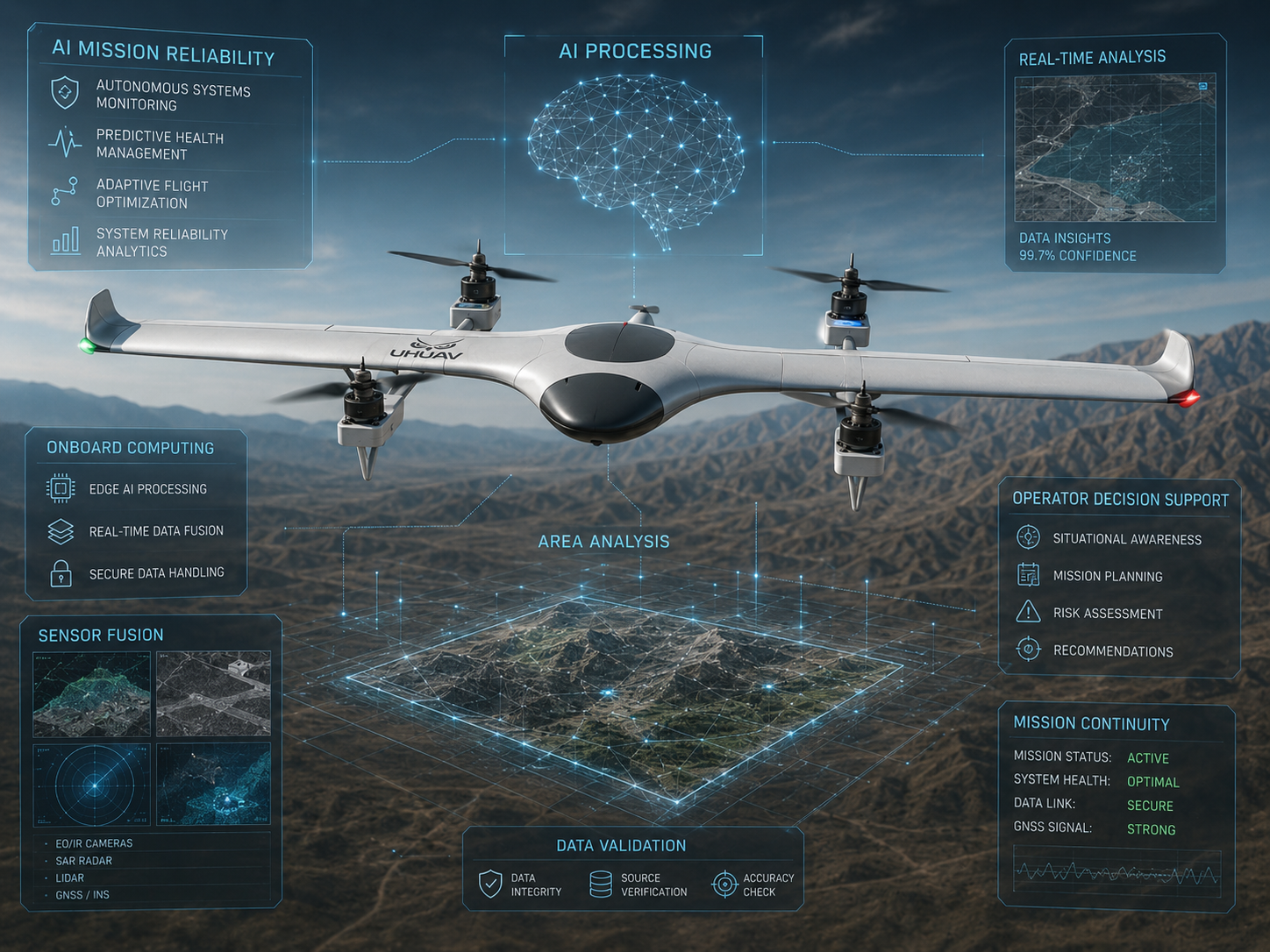
Why AI-Powered Mission Reliability Matters
In modern UAV operations, mission success depends not only on flight capability, but also on the system’s ability to maintain consistency, interpret changing conditions, and support correct decisions throughout the mission cycle. At UHUAV, AI-powered mission reliability is designed to strengthen autonomous drone systems by combining onboard intelligence, mission-aware analysis, and operator-centered control logic. Rather than treating AI as a standalone feature, we use it as part of a broader mission architecture that improves reliability, reduces uncertainty, and supports more stable execution across industrial, security, and mission-specific UAV platforms.
Reducing Operator Workload Through AI-Assisted Mission Control
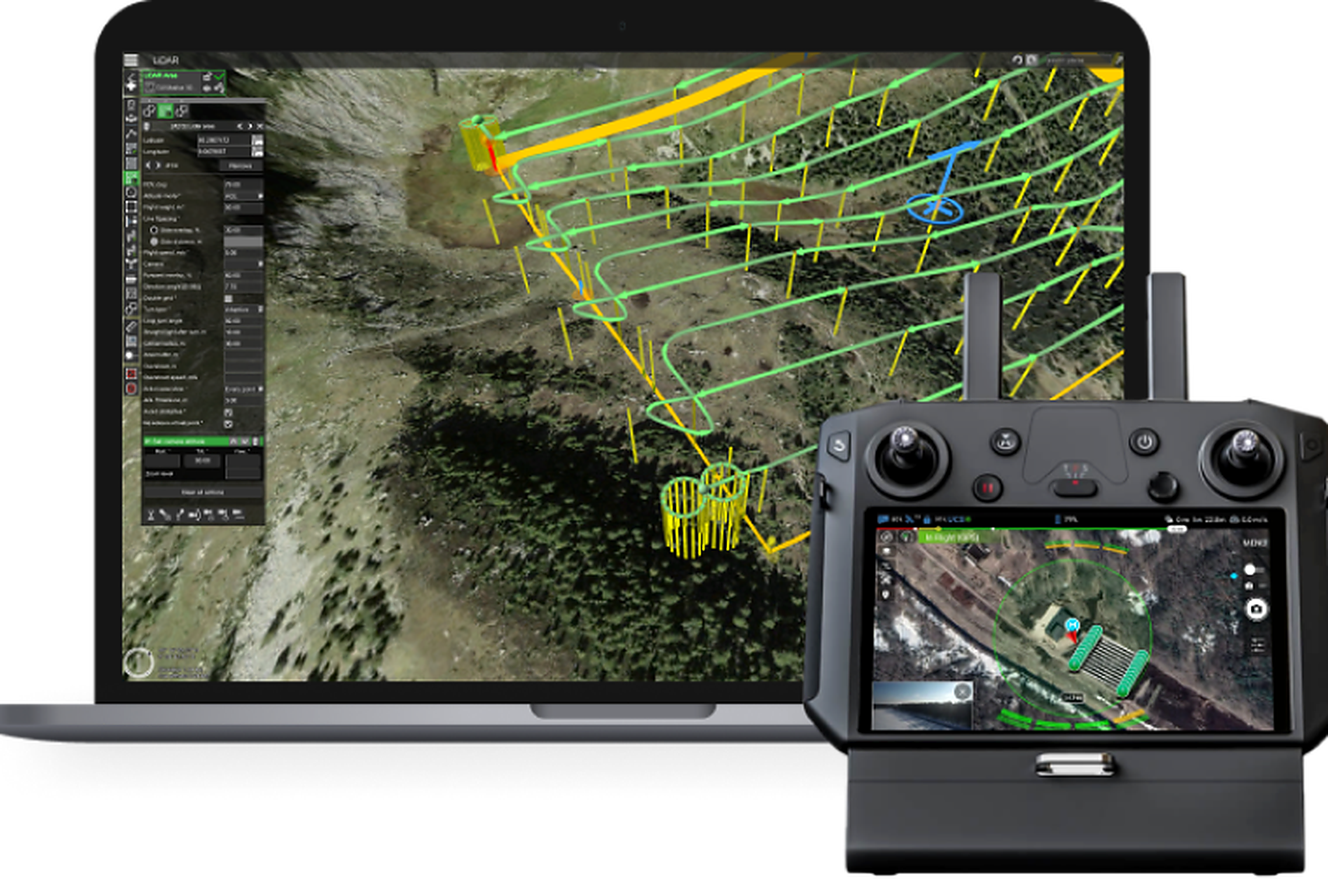
One of the most practical benefits of AI-assisted mission control is the reduction of operator workload during complex UAV missions. In conventional workflows, the operator must simultaneously monitor telemetry, evaluate environmental changes, track mission progress, supervise payload behavior, and interpret sensor data. An AI-powered drone system can reduce this burden by organizing mission-critical information, highlighting relevant changes, and helping the operator focus on decisions rather than raw data interpretation. This creates a more efficient mission-control experience and allows the operator to manage autonomous UAV operations with greater clarity and confidence.
Real-Time Mission Intelligence and Live Data Interpretation
Mission reliability improves significantly when the system can interpret incoming data in real time. UHUAV’s approach to intelligent decision-making in UAV systems is built around the ability to evaluate live telemetry, mission history, flight conditions, and sensor outputs as the mission unfolds. Instead of forcing the operator to manually connect every signal and event, the platform is designed to support real-time mission analysis and faster situational understanding. This is especially valuable in surveillance, inspection, and security-oriented UAV missions where the quality of decisions often depends on how quickly relevant information can be identified and understood.
Multi-Source Data Validation for More Reliable Decisions
A reliable UAV system should not depend on a single sensor, a single signal source, or a single interpretation layer. That is why multi-source data validation is a core part of AI-powered mission reliability. By comparing available mission inputs, onboard sensor readings, route data, and live operational parameters, the system can reduce ambiguity and strengthen confidence in mission-critical decisions. This approach helps minimize mission deviation, supports more stable autonomous mission execution, and improves the overall consistency of mission-specific UAV operations in demanding field environments.
Onboard Computing and Local Decision Support
Mission-critical decisions often need to happen where the action happens. For that reason, onboard computing intelligence plays a central role in reliable autonomous drone systems. Instead of depending entirely on external processing or constant remote interpretation, the UAV can analyze key mission data locally through integrated onboard computers. This architecture supports faster reaction times, more efficient sensor processing, and stronger resilience during dynamic operations. In practical terms, onboard AI helps transform the drone from a remote-controlled platform into a more capable mission asset that can support reliable autonomous behavior closer to the point of execution.
Mission Continuity When Communication Is Degraded
In real-world UAV operations, communication quality may change due to terrain, interference, distance, or contested signal conditions. A mission-ready platform must therefore maintain operational stability even when the drone-to-ground link becomes weaker or partially interrupted. UHUAV’s approach to AI-powered mission reliability supports mission continuity by combining onboard intelligence, predefined mission logic, and local processing capabilities that reduce dependence on uninterrupted external communication. This is particularly important for long-range, industrial, security, and defense-relevant UAV missions where link degradation should not immediately compromise mission consistency or operational safety.
Reliable Performance in GPS-Denied or Challenging Environments
Modern professional UAV missions may take place in environments where navigation certainty is reduced, positioning signals become unstable, or external conditions change rapidly. In these cases, intelligent mission control becomes more than a convenience; it becomes essential for maintaining route discipline and mission reliability. AI-assisted analysis can help the platform interpret changing flight conditions, compare available mission inputs, and support more resilient navigation behavior when the environment becomes less predictable. This makes AI-powered onboard support especially relevant for security, surveillance, and defense-related missions that demand operational resilience under difficult conditions.
AI for Security and Defense-Relevant UAV Applications
In defense-relevant and security-oriented operations, artificial intelligence is increasingly valuable for focused functions such as object recognition, visual interpretation, target tracking, route support, and the analysis of large volumes of mission data. The most effective use of AI in these missions is not unrestricted autonomy, but stronger mission awareness, faster interpretation, and better operator support. UHUAV’s approach aligns with this principle by using AI to improve mission reliability, data interpretation, and operational awareness while preserving operator oversight in autonomous missions. This balance helps ensure that the UAV remains both intelligent and accountable in high-value operational scenarios.
How Intelligent Decision-Making Improves Mission Outcomes
True intelligent decision-making in UAV systems is not only about reacting to problems after they appear. It is about identifying risk earlier, understanding mission conditions faster, and supporting decisions that keep the aircraft aligned with the mission objective. By combining AI-assisted mission control, multi-source data validation, onboard analysis, and real-time mission awareness, the UAV can better maintain route consistency, support payload effectiveness, and reduce the likelihood of mission drift. This produces stronger results in mapping, inspection, surveillance, search operations, and other mission-specific UAV deployments where reliable execution matters as much as flight capability.
AI-Powered Mission Reliability as a Core UHUAV Capability
At UHUAV, AI-Powered Mission Reliability and Intelligent Decision-Making is not treated as an isolated feature, but as a core capability that strengthens the entire UAV mission workflow. From reducing operator workload and interpreting live data to supporting resilience during degraded communication and challenging environments, this mission model is built to improve how autonomous drone systems perform in real operational conditions. The result is a more dependable, more adaptive, and more mission-ready UAV platform for industrial, security, and customer-specific applications.
0 Comments
Add a comment